Research
Here's what we're working on...
Low-dimensional materials (LDMs) are those that have at least one dimension small enough (at the nanoscale) for the physical properties of the material lay somewhere between that of individual atoms and the bulk material. LDMs provide the opportunity to take advantage of every atomic layer to improve the materials' properties and enhance their performance. The LDM lab focuses on the synthesis and processing of advanced LDMs for applications in energy, electronics, and healthcare. The research focus areas include: 2D materials (MXenes, TMDs, graphene, etc.), 1D nanotubes and nanofibers, heterostructures, energy storage and conversion, and electronic biosensors.
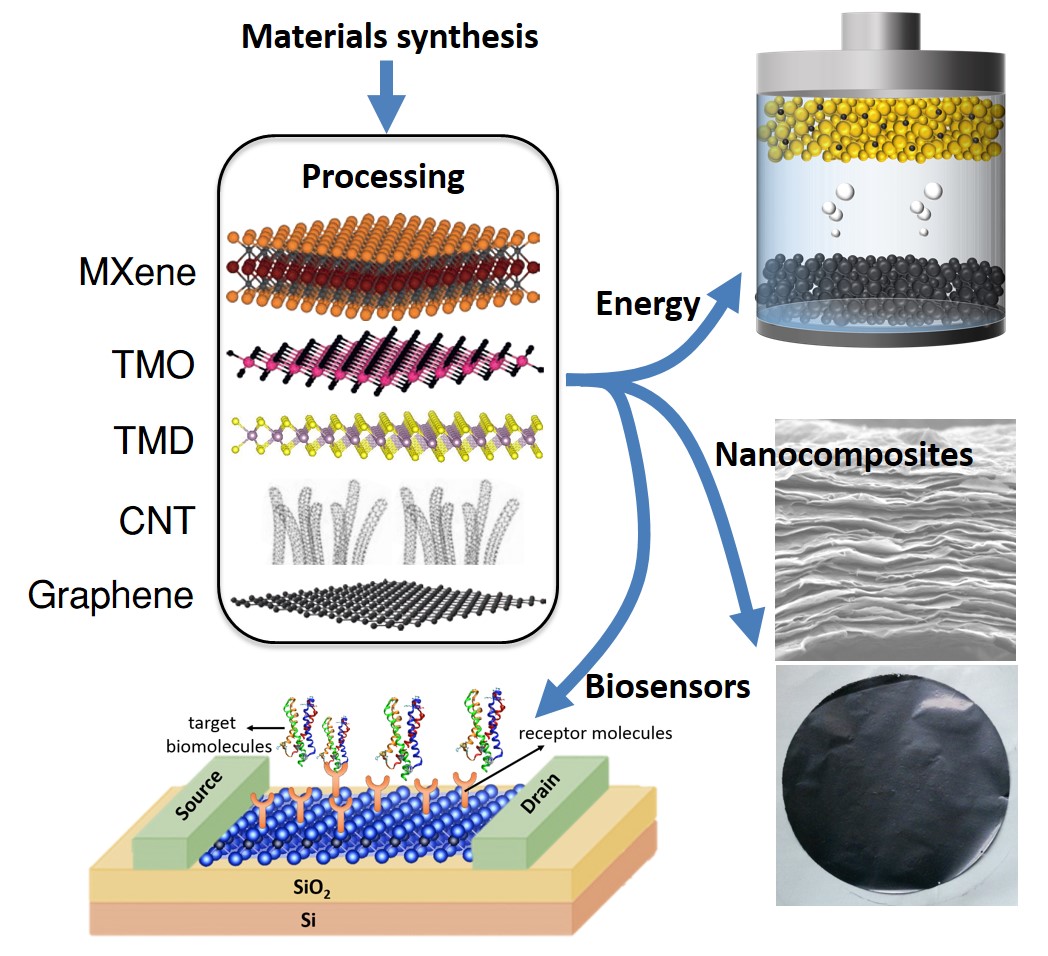
- Synthesis and Processing of Low-Dimensional Materials:
Our group devotes to develop both top-down and bottom-up strategies to synthesize LDMs. Starting from 3D bulk materials, mechanical/chemical exfoliation and selective-etching followed by a delamination process are used to produce materials just one/few atoms thick, or 2D materials. On the other hand, chemical vapor deposition (CVD), wet-chemistry reactions, and topochemical methods are used to build up LDMs from atoms/molecules to synthesize 1D and 2D materials. Proper process techniques are to be developed to assemble these LDMs into 3D macroscopic films and fibers for ultimate utilization of their performance in energy and electronic devices. The materials of interest include 2D MXenes, TMDs, TMOs, graphene, hBN, etc., 1D nanotubes and nanofibers, and their heterostructures and nanocomposites.
- Low-Dimensional Materials for Electronics and Nanosensors:
Nano/micro-fabrication process will be used to fabricate the LDM-based electronic devices. We intend to investigate the electronic transport as well as other electronic properties of novel LDMs. LDM-based electronics are to be used to detect chemical and biomolecules such as PFAS, HABs, heavy metals, DNA, and proteins, for point-of-care environmental and health monitoring purposes.
One major focus of our lab is to develop 2D materials based nanosensors for PFAS detection in water and air. We have developed an hBN-assisted universal functionalization method to functionalize 2D materials, with PFAS probe molecules. This successful functionalization facilitate the fabrication of 2D materials based field-effect transistor and resistor nanosensors for PFAS detection in both water and air. Short response time, high sensitivity, and good selectivity were achieved. We also also developing prototype of such nanosensors for on-site, real-time monitoring of PFAS impacted water and air.
Sponsors: New Jersey Water Resources Research Institute, New Jersey Health Foundation, US Environmental Protection Agency, U.S. Department of the Interior - Bureau of Reclamation, etc.
- Low-Dimensional Materials for Energy Storage and Conversion:
The unique electronic, optical, mechanical, and chemical properties of LDMs originated from the quantum confinement effect and high surface area to volume ratio renders their great potentials for applications in energy storage and conversion. One major focus of our lab is to utilize the LDMs and their heterostructures and nanocomposites to develop next-generation energy storage and conversion devices, including batteries, supercapacitors, and full cells.
- Low-Dimensional Materials for Environmental Applications: PFAS remediation, air filtration
The unique chemical and physical properties of LDMs also promote their application in environmental protection. Our lab is working on the development of 2D MXene-based membranes or films for water and air purification. Specially, we are developing MXene-based composite membranes for PFAS adsorption, desorption, and destruction. We are also developing MXene-based surface coatings for antiviral air filtration.