Researchers
|
Ayushi K Sangoi, PhD Candidate |
Farzin Hajebrahimi, Ph.D. |
|
Melissa Noble, MSW |
Paul Booth, PhD student |
Dr. Alvarez's team is the first to quantify how vision rehabilitation evokes neuroplasticity for people with convergence insufficiency, a visual dysfunction presented in almost 50% of individuals living with TBI. Our team conducts a study and quantified changes from vision rehabilitation through improvements in oculomotor behavior and functional MRI.
This research is discovering how the brain retains itself using its existing “real estate” to regain oculomotor function. It can be translated into better and more efficient treatments for people, resulting in more functionality in potentially a shorter period of time. The goals of this lab are to understand how the visual system interoperates with the brain.
Dr. Chang Yaramothu was a Postdoctoral Research Associate in the Vision and Neural Engineering Laboratory (VNEL) at NJIT. He wore many hats including Vision and Concussion Researcher and Virtual Reality Developer. He is currently an Assistant Professor of Engineering Technology and Biomedical Engineering at NJIT and actively collaborates with VNEL.
He graduated from New Jersey Institute of Technology (NJIT) and its Honors College with a B.S. in Biomedical Engineering (BioInstrumentation Specialization) in May 2013, with an M.S in Biomedical Engineering (Neural Engineering Specialization) in May 2014, and a Ph.D. in Biomedical Engineering in December 2017.
At VNEL he was currently involved in two main projects. The first is to develop a methodology for quantifying concussion through objective biomarkers. This research work involves eye movements, concussion, functional imaging, and developing portable instrumentation so these systems could be deployed on a soccer field or a hospital.
His second project is to develop, design, and integrate custom-made eye-tracking software into existing virtual reality headsets. My goal is to draw my vision and concussion expertise into the virtual reality world, making these mundane medical procedures, diagnoses, and therapies into fun and exciting games.
Check out his lab website: Sensorimotor Quantification & Rehabilitation Laboratory

John Vito is a Associate Researcher at VNEL. He graduated from New Jersey Institute of Technology and its Honors College with a B.S. in Biomedical Engineering, Biomechanics Specialization, in May 2016, and an M.S. in Biomedical Engineering in 2017. John Vito worked as a student researcher at VNEL for three years, where he completed his Master’s Thesis, “Virtual Reality Vision Therapy.” He was the recipient of over thirty thousand dollars in support for his research, including an IEEE EPICS grant and first place in NJIT’s TechQuest competition. Total funding for his project has exceeded one hundred thousand dollars. He was awarded the NJIT’s 2017 Presidential Leadership Award for his dedication to the NJIT community during both his undergraduate and graduate careers.
As a virtual reality developer, John Vito designs novel integrations of consumer-ready virtual reality headsets and custom-made eye tracking hardware and software, as well as therapeutic gaming software, and is currently starting his own business.
Check out his website, web.njit.edu/~jd329.
Eye Tracking Instrumentation
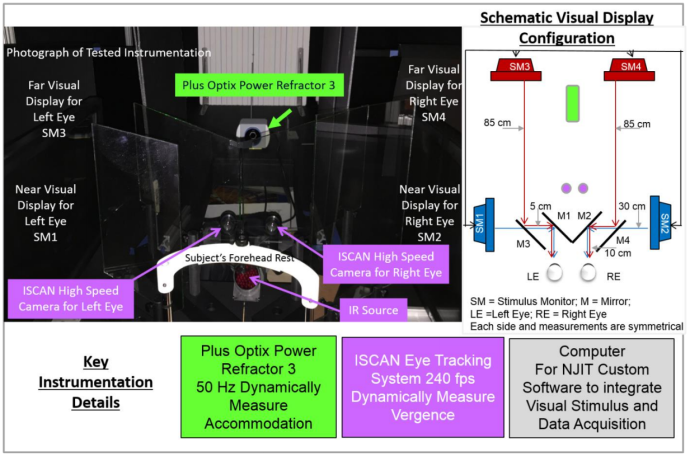
Our haploscope is custom designed by the Vision and Neural Engineering Laboratory of NJIT, funded through an equipment grant from the National Science Foundation. The key novelty is the ability to measure eye movements and accommodation dynamically and simultaneously, using an ISCAN Inc. 240Hz camera system and a PlusOptix Power Refractor 3, respectively. This is achieved through a series of mirrors and monitors. The software, VisualEyes2020, is all custom from NJIT written in LabVIEW. To the best of our knowledge this is the only instrument of its kind. The beauty of the system is there are no moving parts. We use four computer monitors (Stimulus monitors = SM1, SM2, SM3, and SM4). Visual stimuli are presented on one or multiple computer monitors. Hence, we can present a monocular target that is only present on SM4 and SM2 which would stimulate accommodative vergence. We can present stimuli binocularly on SM1 and SM2 which would stimulate disparity vergence. We can also use only 1 stimulus monitor and change the scale (also called looming) which stimulates proximal vergence.
Function Near Infrared Spectroscopy
Our Techen CW6 fNIRS device is a noninvasive optical brain monitoring device. Functional near-infrared spectroscopy (fNIRS) is a relatively new non-invasive functional imaging tool. fNIRS capitalizes on the different absorption characteristics of oxygenated (HbO) and deoxygenated (HbR) hemoglobin under 600 – 900 nm infrared light to detect individual differences within their concentrations. The scattered and re-emitted infrared light is measured by the detector 10 – 40 mm distance from the source. This source-detector distance induces a light penetration depth of 2 – 8 mm of the cortex. The theoretical observed brain region is approximately the centroid of the source and detector optodes, roughly 15mm below the scalp. Scattering of light creates a banana shaped pathway between the optodes, making the observed signal an aggregate of that pathway. This collective signal would contain the hemodynamic concentrations from the neruovasculature, grey matter and white matter. Our instrument is integrated with a Brainsight Neural Navigator for exact placement of optodes.
Autorefractor
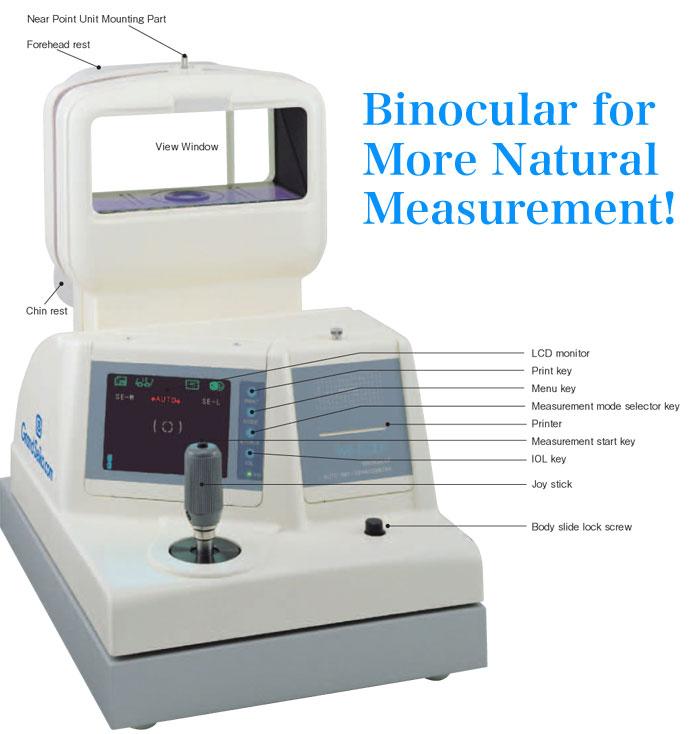
Our Grand Seiko WR-5100K autorefractor measures accommodation dynamics. It was purchased with the PI’s NSF Major Research Instrumentation grant.
VNEL has many ongoing collaborations across the United States.
Mitchell M. Scheiman, OD, PhD, FAAO
Dean of Research
Professor
Pennsylvania College of Optometry
Salus University
Susan A. Cotter, OD, MS, FAAO
Professor
Southern California College of Optometry
Marshall B Ketchum University
Davin Quinn, MD
Associate Professor
Division Chief, Behavioral Health Consultation and Integration
Department of Psychiatry and Behavioral Sciences
University of New Mexico
Arelen Goodman, MD
Pediatric Sports Medicine
Sports Medicine Institute
Saint Peter's University Hospital
Email: vnel@njit.edu
Phone: (973) 596-5385
Park in the NJIT Deck at 154 Summit Street, Newark, NJ 07103. Exit the parking deck at the front, and turn right, walking along Summit Street (crossing over Warren Street) through the NJIT Campus. Fenster Hall (building #8 on the map) is identified by the overhead pedestrian bridge that connects it to another building, it should be clearly visible. There is a campus map near the parking deck if you need additional direction. Our lab is on the 6th floor of Fenster Hall, room 695, which is all the way at the end of the hallway on the left.
Tara Alvarez, Ph.D. is a professor of biomedical engineering, director and founder of the Vision and Neural Engineering Laboratory and director of the Undergraduate Biomedical Engineering Program. She is the lead engineer within a team that is making a difference in treating vision function in brain injury patients, especially children with concussion. Specifically, she is establishing new clinical standards for treating patients with vision dysfunction following brain injury and is working with five major children’s hospitals to assess the effectiveness of her system. This will result in broader impact to further understand what is different in patients with convergence insufficiency (CI) and how the brain changes post-vision therapy. Her system is more cost-effective and can be used within the comfort of one’s home or by a broad array of health care professionals which will revolutionize the way in which people are diagnosed and treated.
The mission of her research is to understand the underlying neural mechanisms that lead to a sustained reduction in visual symptoms and to take that knowledge, integrated with technology, to develop new diagnostic and therapeutic interventions that can be used for personalized point-of-care.
Alvarez’s research was the first to examine the link between vision therapy and the brain. Using functional magnetic resonance imaging (fMRI), she was able to document how the brain changed as a result of vision therapy. In 2016, she and her clinical collaborators published the first paper examining convergence in patients with concussion before and after vision therapy. They showed that the patients’ eye movements improved significantly following therapy. Their proposal, entitled CICON (Convergence Insufficiency in Concussion) will study CI in children with concussion. Alvarez is the lead engineer for CICON and will be installing her novel instrumentation at Children’s Hospital of Philadelphia, Boston Children’s Hospital, the University of Alabama at Birmingham Children’s Hospital, Southern California College of Optometry and Akron Children's Hospital in Ohio. With the knowledge acquired since 2001, she and her team are designing innovative diagnostic and therapeutic interventions with NJIT’s Game Design program.