3D and Non-Planar Electrode Architectures for Field-Compatible Sensing
...
3D and Non-Planar Electrode Architectures for Field-Compatible Sensing
Our Approach
Our lab develops advanced 3D and non-planar electrode systems to overcome the limitations of traditional planar sensors in microfluidic environments. By integrating porous, vertically aligned interdigitated electrodes into layered microfluidic devices, we create high-surface-area, immersive electrochemical interfaces that significantly enhance analyte capture, electric field intensity, and signal transduction. These devices are fabricated using low-cost, scalable methods and are specifically designed to operate autonomously in point-of-care (POC) and point-of-use (POU) settings.
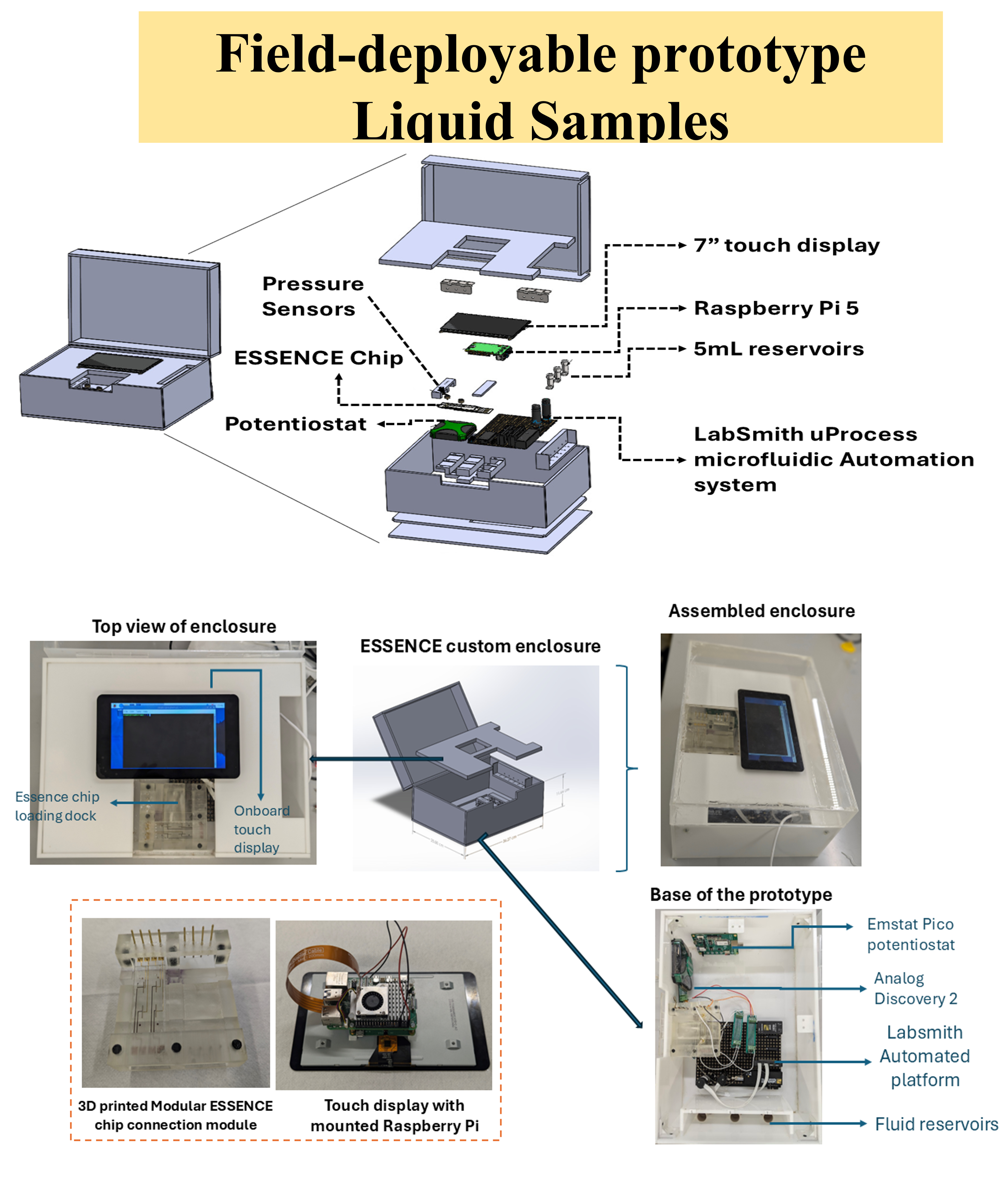
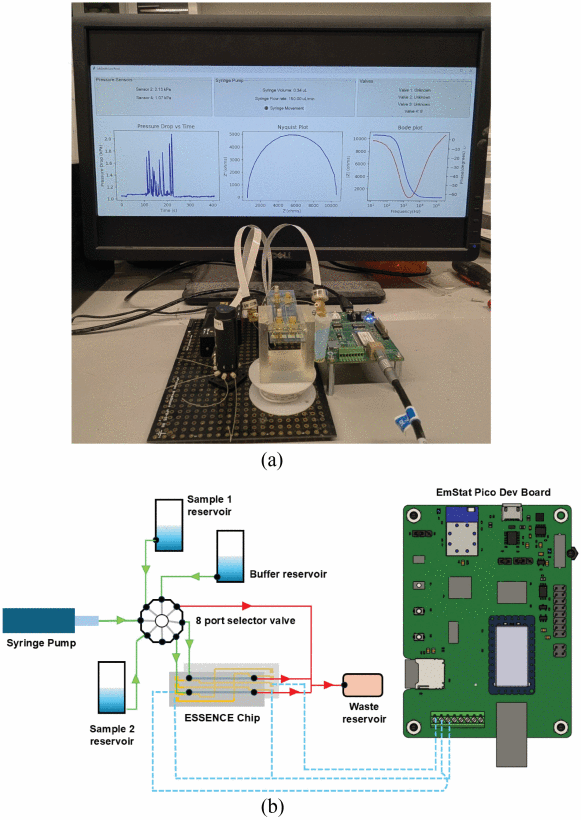
We unify microfluidic automation, embedded pressure monitoring, and electrochemical impedance spectroscopy (EIS) into a fully programmable platform that operates through open-source Python control. This system—centered around our ESSENCE (Electrochemical Shear-Enhanced Non-Planar Capacitive Electrode) chip—enables real-time diagnostics with minimal human intervention.
Key Capabilities
- Non-planar Interdigitated Electrodes (NP-μIDEs): Patterned on both top and bottom channel surfaces to maximize 3D field strength and electrode-analyte interactions.
- Porous Electrode Integration: Facilitates improved ionic transport and increased surface contact for higher sensitivity.
- Automated Microfluidic Flow Control: Enables sequential reagent handling, wash steps, and sample routing using LabSmith hardware and Python automation.
- Embedded Impedance Sensing: Real-time EIS readouts with programmable workflows for high-resolution detection of molecular interactions.
- Pressure Monitoring: Built-in diagnostics to detect clogging, leakage, or displacement of packed materials in real time.
Applications & Impact
Our systems are designed for operation in challenging, resource-limited environments, enabling rapid, reliable detection of:
- Nucleic acids (e.g., pathogen-specific DNA/RNA)
- Environmental contaminants (e.g., PFAS, heavy metals)
- Biomolecular markers for disease diagnostics
- Real-time monitoring of filtration membrane fouling
The modular, scalable nature of our platform makes it well-suited for global health, environmental fieldwork, and on-site water quality testing. Our research supports the vision of decentralized diagnostics—where robust, portable biosensors can deliver lab-grade results at the point of need.
Recent Publication
N. H. Menon, Y. Beshai and S. Basuray, "Fully Automated Microfluidic Electrochemical Platform as a Versatile Biosensor," in IEEE Sensors Letters, vol. 9, no. 8, pp. 1-4, Aug. 2025, Art no. 4501404, doi: 10.1109/LSENS.2025.3588757.